

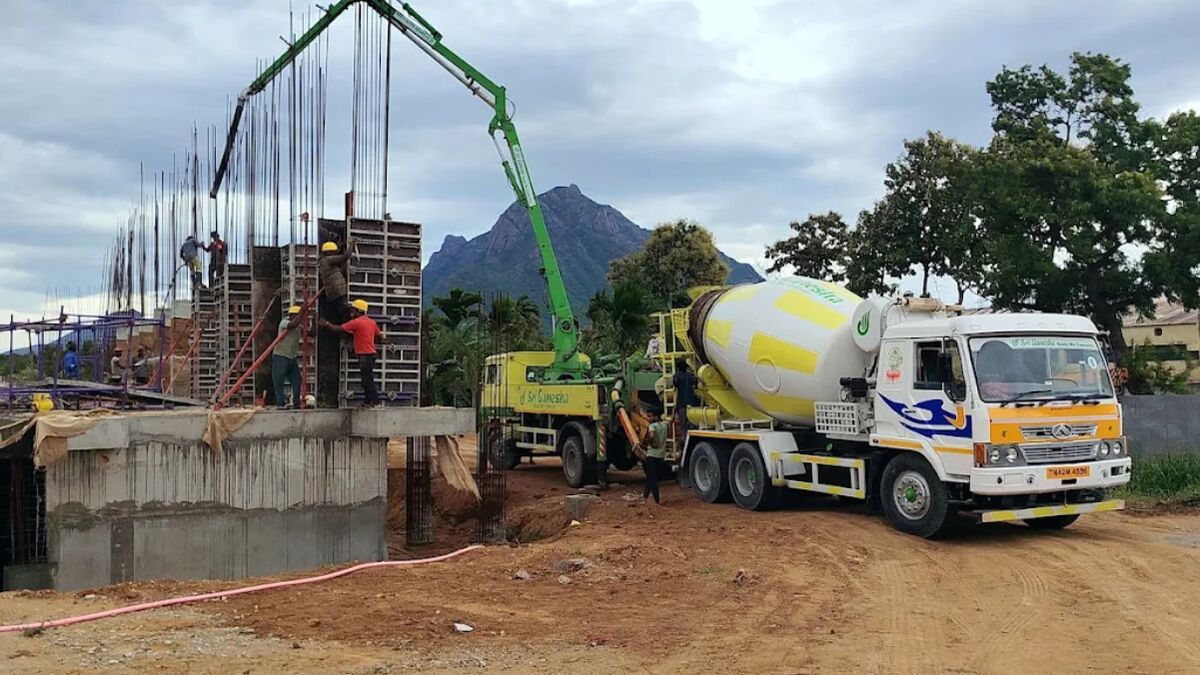
Ready-mix concrete arrives ready to place, so the site has to be ready too. Delays can leave trucks waiting, affect workability and even create cold joints in your slab. A little planning before pour day makes the work faster, safer and better in quality.
1. Confirm the order details
- Check the grade, slump and special requirements on your drawings, and confirm them with us.
- Calculate the volume from the formwork dimensions and allow a small margin. Our concrete estimator gives the volume and the number of 9 m³ transit mixer loads.
- Agree the pour date, start time and truck interval, so concrete arrives at the rate your crew can place it.
2. Plan access for trucks and pumps
- Make sure the approach road and gate are wide and firm enough for a loaded transit mixer, even after rain.
- Clear overhead cables and branches.
- For a boom pump, mark a level, firm spot with room for its outriggers and for trucks to reverse up to it. For a stationary pump, plan the pipeline route.
- Keep a wash-out spot for trucks away from the work area.
3. Check formwork and reinforcement
- Formwork should be strong, propped, aligned and tight at the joints so it does not leak or move.
- Reinforcement should be tied at the right spacing and supported on cover blocks.
- Clear debris, sawdust and standing water, and lightly wet absorbent surfaces.
- Get the engineer’s approval of formwork and steel before the first truck is dispatched.
4. Get your crew and equipment ready
- Arrange enough workers to place, compact and finish at the delivery rate.
- Keep needle vibrators (with a spare), screed boards, trowels, shovels and lighting ready and tested.
- Plan the pour sequence so construction joints fall only where the engineer allows them.
5. On pour day
- Check the delivery ticket against your order for grade and quantity before discharge.
- Do not add water to the concrete on site. Extra water lowers strength and durability; ask for a more workable mix when you order instead.
- Place concrete close to its final position and compact it thoroughly to remove trapped air.
- Place each load promptly. IS 4926 generally expects ready-mixed concrete to be discharged within about two hours of batching, unless the mix is designed for longer.
- Cast cube samples where required so the strength can be verified.
6. Plan the curing in advance
Curing starts as soon as the surface can take it, so keep water, wet hessian, sheeting or curing compound on site before you start. Concrete generally needs at least 7 days of moist curing, and longer for blended cements or in hot, dry weather. Our guide to curing of concrete covers the methods that suit your site.
Need help planning your pour? Our team can visit the site, check access and recommend the right pump and delivery schedule for your project.