
01 · Strong Foundations of Quality
Strict Quality Protocols
Get to know our strict quality protocols that maintain consistency from material sourcing through to the construction site.
Carefully Selected Materials
We carefully choose aggregates and admixtures from approved suppliers, supported by mandatory Material Test Reports (MTRs).
Accurate Mix Batching
Our computerized batching plants maintain accurate mix proportions within a ±1% tolerance, reducing manual errors.
Advanced Testing Laboratories
We are fully equipped with advanced laboratories for real-time testing of both fresh and hardened concrete.
Quality Control through Data Analysis
We analyse our compressive strength data on a regular basis to ensure consistency and low standard deviation, and a high coefficient of variation.
02 · Quality Assurance
Have a Glimpse of Our Quality Control Workflow
Material Verification
- Aggregate gradation analysis
- Moisture level assessment and correction
- Cement property verification
Fresh Concrete Checks
- Slump consistency testing
- Concrete temperature measurement
- Transit mixer condition inspection
Hardened Concrete Assessment
- Compressive strength testing at 7 and 28 days
- Flexural strength evaluation
- Non-Destructive Testing (NDT), when required
03 · State-of-the-Art QC Laboratory
Precision-Driven Testing System for Strict Quality Control in Every Batch
04 · Post-Supply Protocol
Post-Pour Care
We ensure post-supply care to maintain the strength, durability, and long-term performance of concrete after placement.
Essential · Primary Curing
Proper Curing
The right moisture and temperature conditions should be maintained for a minimum of 7 to 10 days. Techniques like water ponding or covering with wet hessian prevent plastic shrinkage cracking and support complete cement hydration.
Site Protection
The fresh concrete must be protected from rain, direct sunlight, and movement of construction workers. The area should be fenced off until the concrete becomes sufficiently strong.
Cube Strength Testing
Our support includes assisting site teams with the preparation of concrete cubes for 7-day and 28-day strength testing. In this way, we can verify that concrete is compliant with design specifications.
Curing Guide
Follow essential curing practices to support concrete strength, durability, and long-term performance.
View MoreCrack Prevention
Proper curing, protection, & methods applied at the site minimize the risk of cracking and ensure the performance of concrete.
View More05 · Commonly Raised Questions
Quality Intellect & FAQs
Find technical answers regarding mixing timelines, quality benchmarks, strength criteria, and site-level curing guidelines.
Is Adding Extra Water at Site Recommended?
Strictly no! Adding water results in a change of the water-cement ratio and can reduce concrete strength and durability. Admixtures in the form of superplasticizers are used as appropriate under supervision to enhance workability.
What Leads to Concrete Cracking?
Cracks can occur due to plastic shrinkage, often caused by rapid moisture loss from heat or wind. Surface cracking can be avoided using early curing. Structural cracking occurs rarely and can be caused by excessive loading or improper preparation of the sub-base.
OPC vs PPC: How Do They Differ?
OPC (Ordinary Portland Cement) develops strength faster, making it suitable where early demoulding is required. PPC (Pozzolana Portland Cement) gains strength more gradually but provides better long-term durability and chemical resistance. The suitable cement type is selected based on your project’s structural requirements.
Why Does Honeycombing Occur in Concrete?
When aggregates are exposed, creating honeycombing, the causes may be insufficient vibration or segregation during the process of concrete casting. Honeycombing can also give rise to weak concrete sections. The problem can be avoided through the efficient use of a needle vibrator during pouring.
Why Are Concrete Cube Tests Necessary?
Cube testing helps measure the compressive strength of concrete supplied for construction purposes and check its conformity to the given design grade, such as M25 or M30. The 7-day test provides an early strength indication, while the 28-day test verifies the required design strength.
05 · Our Certifications
Certified for Quality & Trust
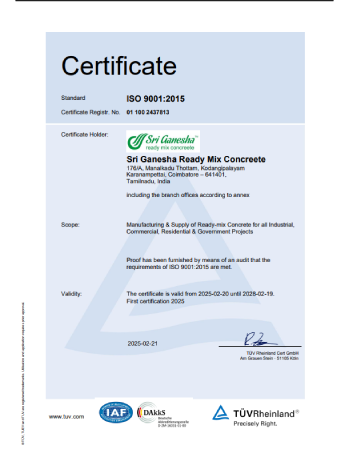
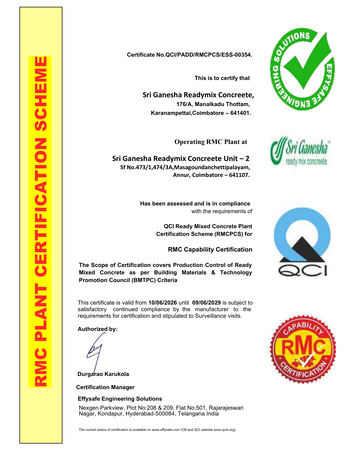
Our certifications reflect the standards we follow in every batch. Click a certificate to open it in a new tab.